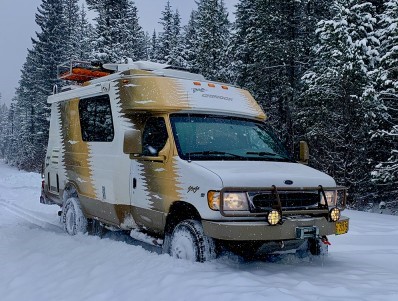
Looking for a pre 1997 Chinook concourse Owner
-
kyidletime
- Posts: 154
- Joined: September 8th, 2015, 4:02 pm
Re: Looking for a pre 1997 Chinook concourse Owner
Thanks again. I only have one house battery and it's located under the hood. The battery that is there looks to be smaller in size that the battery tray. I'm thinking that someone had put this battery in to replace what should be there. I will take your advice and do some checking, and take my battery in to a parts store to have it bench tested.
Alan Croy
Hamilton, Ohio
1995 Chinook Concourse
Upgraded Converter/Charger System.
Hamilton, Ohio
1995 Chinook Concourse
Upgraded Converter/Charger System.
Re: Looking for a pre 1997 Chinook concourse Owner
ahh gotcha.. forgot about the ambulance type setup. I'm still a proponent of AGM now. My brother is all about LiPro's, but the cost to benefit doesn't line up to me (odd since he's usually the cheap skate haha).
If it's indeed bad, I'd measure to see just how big of a battery I could safely put there, then buy an AGM in that size. Heck, I think I'll use AGM for my starting battery when it goes bad (unless AGM's aren't good as a starting battery for some reason.. haven't done that research yet)
If it's indeed bad, I'd measure to see just how big of a battery I could safely put there, then buy an AGM in that size. Heck, I think I'll use AGM for my starting battery when it goes bad (unless AGM's aren't good as a starting battery for some reason.. haven't done that research yet)

Re: Looking for a pre 1997 Chinook concourse Owner
Just like Manitou said, your DC powered things should run without being plugged in or having the generator on.
What *won't* run without being plugged in or having the generator on, are AC things (unless you have an inverter, but that's something that wouldn't have been stock so we'll ignore that for now). Examples of what won't run unless you are plugged in or have the generator on are as follows:
- AC outlets (and anything you plug into them).
- Microwave oven
- Air-conditioner
In other words, most things will (should) run when not plugged in or having generator on. Lights, refrigerator, furnace, vent fans, water pump (faucets), water heater, etc.
If these things are not running, then there is a problem somewhere in the DC system. It could very well be the house battery, but it could also be something else along the line. Here is something you could check: Take your meter and put it on voltage/20 volts. Then (after you haven't been plugged in or using anything for say, overnight, so the battery is "resting"), put it across your two house battery terminals and read the voltage. If the voltage is in the 11 volt range, then the low battery voltage may be keeping things from working. If it's "good" (over 12 volts), then at least SOMETHING should light up slightly. What I mean is, even a fairly bad battery should be able to start up a small lamp.
In the post-1997 rigs the LVD has a low voltage cutoff, so it's quite possible that a low battery could mean NOTHING works. But I don't *think* your rig has that, so even a low battery might wanly do something, even if dim.
So that makes me wonder if for some reason the power is not flowing from house battery to house DC loads. If you get a decent voltage reading on the battery, then what happens if you put a meter across the main terminals on your fuse block? In other words, is power being held up somewhere between the house battery and the DC loads? I'm a bit suspicious since the dash switch has been monkeyed with (by PPO). We know the fuse block and downstream works, because they work when you are plugged in (and power gets to them via the charger).
Looking on the bright side, you are going to be much more familiar with your rig when you get this all sussed (and that knowledge will be useful in any other future RV too). I felt like I already had the basics (from boating) when I bought my Chinook, but in the process of re-wiring my rig and a friend's (the friend's was more of a "learning experience" due to no documentation and having to figure out the stock wiring first before we could improve it), I gained knowledge.
I know I probably sound like a broken record, but ultimately the option still exists to just wire in new main feeds (what I mean is, the stuff between the batteries and to the fuse block on the DC side) and then know what you have. But I don't blame you a bit for first trying to get what you have figured out and operational. I just wanted to reiterate that it's an option though. New would be better, more modern, and more robust. But it would also cost some money, and there is something satisfying about figuring out an existing system too.
I'm starting to wonder: Did Chinook only build like two 1995 era rigs? Where are they?
What *won't* run without being plugged in or having the generator on, are AC things (unless you have an inverter, but that's something that wouldn't have been stock so we'll ignore that for now). Examples of what won't run unless you are plugged in or have the generator on are as follows:
- AC outlets (and anything you plug into them).
- Microwave oven
- Air-conditioner
In other words, most things will (should) run when not plugged in or having generator on. Lights, refrigerator, furnace, vent fans, water pump (faucets), water heater, etc.
If these things are not running, then there is a problem somewhere in the DC system. It could very well be the house battery, but it could also be something else along the line. Here is something you could check: Take your meter and put it on voltage/20 volts. Then (after you haven't been plugged in or using anything for say, overnight, so the battery is "resting"), put it across your two house battery terminals and read the voltage. If the voltage is in the 11 volt range, then the low battery voltage may be keeping things from working. If it's "good" (over 12 volts), then at least SOMETHING should light up slightly. What I mean is, even a fairly bad battery should be able to start up a small lamp.
In the post-1997 rigs the LVD has a low voltage cutoff, so it's quite possible that a low battery could mean NOTHING works. But I don't *think* your rig has that, so even a low battery might wanly do something, even if dim.
So that makes me wonder if for some reason the power is not flowing from house battery to house DC loads. If you get a decent voltage reading on the battery, then what happens if you put a meter across the main terminals on your fuse block? In other words, is power being held up somewhere between the house battery and the DC loads? I'm a bit suspicious since the dash switch has been monkeyed with (by PPO). We know the fuse block and downstream works, because they work when you are plugged in (and power gets to them via the charger).
Looking on the bright side, you are going to be much more familiar with your rig when you get this all sussed (and that knowledge will be useful in any other future RV too). I felt like I already had the basics (from boating) when I bought my Chinook, but in the process of re-wiring my rig and a friend's (the friend's was more of a "learning experience" due to no documentation and having to figure out the stock wiring first before we could improve it), I gained knowledge.
I know I probably sound like a broken record, but ultimately the option still exists to just wire in new main feeds (what I mean is, the stuff between the batteries and to the fuse block on the DC side) and then know what you have. But I don't blame you a bit for first trying to get what you have figured out and operational. I just wanted to reiterate that it's an option though. New would be better, more modern, and more robust. But it would also cost some money, and there is something satisfying about figuring out an existing system too.
I'm starting to wonder: Did Chinook only build like two 1995 era rigs? Where are they?
1999 Concourse

Re: Looking for a pre 1997 Chinook concourse Owner
Sorry if this is off topic.... but I’m a recent Chinook owner, and I have a clean copy of the Premier/Concourse owner’s manual for model year 1994. Most importantly, it has the schematics. Is this useful for the archives? I’d be happy to provide a scanned .pdf if so. Where should I send it?
1994 Premier
Re: Looking for a pre 1997 Chinook concourse Owner
I think having manuals here is a great idea. I have uploaded a couple of similar things. However, I don't think there is (yet?) a specific place for them. As I remember it, I just made sure to put plenty of text in the post that contained them, so that anyone searching could easily find it. As such you could just make a reply to this post/thread, and upload it there. Just make sure to say things like "1994 Concourse manual" or etc. in the text to help people searching (and too, then it could be found and moved if we ever have a specific documentation section here).
You can upload it yourself (Manitou has now allowed .pdf files for this reason). Just use the upload area below the posting box, and "browse" will bring you to your own files on your computer where you can select it and then upload it and then place it "inline" (if you have any questions on that, fire away!).
I think your manual would be most welcome, being one of the rarer birds.
BG
You can upload it yourself (Manitou has now allowed .pdf files for this reason). Just use the upload area below the posting box, and "browse" will bring you to your own files on your computer where you can select it and then upload it and then place it "inline" (if you have any questions on that, fire away!).
I think your manual would be most welcome, being one of the rarer birds.
BG
1999 Concourse
-
kyidletime
- Posts: 154
- Joined: September 8th, 2015, 4:02 pm
Re: Looking for a pre 1997 Chinook concourse Owner
I'd be interested in seeing your manual Scott, you might want to start a new thread and make it more searchable with a descriptive title like BG said.
Getting back to my inquiry about my battery, do you suppose that the wires that aren't attached to a battery disconnect switch on my rig, have any bearing on my DC system not working on its own?
Getting back to my inquiry about my battery, do you suppose that the wires that aren't attached to a battery disconnect switch on my rig, have any bearing on my DC system not working on its own?
Alan Croy
Hamilton, Ohio
1995 Chinook Concourse
Upgraded Converter/Charger System.
Hamilton, Ohio
1995 Chinook Concourse
Upgraded Converter/Charger System.
Re: Looking for a pre 1997 Chinook concourse Owner
Not to say that starting a new thread is not a good idea; but I think that just having terms in the text of a post will also make it show up in search. So either way could work. Alan, I figured you'd be interested in it!kyidletime wrote:I'd be interested in seeing your manual Scott, you might want to start a new thread and make it more searchable with a descriptive title like BG said.
This was my exact thought. I mean, look at it this way. You have a "modified" system, and there's a good chance that the PPO didn't just decide to do this out of the blue. I mean, there is probably at least a 75% chance it was modified in reaction to a problem, that may or may not have been solved (not that people can't modify "just because," but looking at how the old switch was removed/replaced..... not exactly surgical quality). I see two paths you can take:kyidletime wrote:Getting back to my inquiry about my battery, do you suppose that the wires that aren't attached to a battery disconnect switch on my rig, have any bearing on my DC system not working on its own?
1) Continue to test and document, with the goal of figuring out what is going on, what works, and what doesn't work. This can lead to a number of other options, depending on what you find (reproduce old system, modify old system, reject old system).
2) Just put in a new system, configured how you would like it to work.
I can see good reasons to do either or both. My only "worry" (for your sake) is that you don't spend so much time and mental effort (and maybe stress) in figuring out an old/outdated system, that it robs you of the pleasure of your new Chinook. I don't know you, so I don't know if there is even a grain of truth to that; lots of people enjoy this sort of thing, so you may be enjoying it. I don't see any "wrong" way to go about it - just options.
But yeah, seeing the mods would raise a sliver of suspicion that maybe all was not right when they were undertaken, and some of that may still remain.
1999 Concourse
-
kyidletime
- Posts: 154
- Joined: September 8th, 2015, 4:02 pm
Re: Looking for a pre 1997 Chinook concourse Owner
I'm that kind of guy, I like challenges and like keeping busy. Actually though in the long run I like the idea that you suggested of going the Bluesea 7622 route that you suggested. I think tomorrow I' do some checking on the battery, and make looking to replace it with a proper battery as Manitou suggested, maybe an AGM, what do you think?
Alan Croy
Hamilton, Ohio
1995 Chinook Concourse
Upgraded Converter/Charger System.
Hamilton, Ohio
1995 Chinook Concourse
Upgraded Converter/Charger System.
Re: Looking for a pre 1997 Chinook concourse Owner
Good to know. Glad it's somewhat fun/challenging instead of just discouraging. I agree that it's satisfying to figure things out.kyidletime wrote:I'm that kind of guy, I like challenges and like keeping busy.
Understood. I'd be the same. At this point you are not sure your ultimate RV-ing use style, so why not put off those decisions if possible (because different styles/goals = different implementation).kyidletime wrote:Actually though in the long run I like the idea that you suggested of going the Bluesea 7622 route that you suggested.
Actually, I would vote no on an AGM. I'll explain why.kyidletime wrote: I think tomorrow I' do some checking on the battery, and make looking to replace it with a proper battery as Manitou suggested, maybe an AGM, what do you think?
First of all, it's not that I'm not a fan. I have both an AGM start battery and an AGM house bank (three batteries) in my Chinook, and I think they were a good choice. However, like most things, there are plusses and minusses, and from what I know, I'm not sure the plusses line up with what you are doing right now.
AGM plusses:
1) You don't need to check or add water, as you do to flooded cell batteries.
But, your battery is easy to get to, so this is not a huge advantage. I mean, you'll be under the hood checking oil and etc. anyway, and your house battery is easily accessible.
2) You can put them in any orientation except upside down.
This can be a plus in awkward places, but you have no problem putting a battery right-side up in your location.
3) They don't outgas in the same way/amount as flooded cells.
But your battery is essentially outside, so this is of no real advantage to you.
4) They can accept charge really quickly.
But your charger is older/lower amperage, so you don't really have any real need for them to accept a huge charge quickly.
AGM minusses:
1) They are more expensive than flooded cell batteries. This gets you when you buy it, and if you have to replace it, gets you again.
2) They like to have very specific charging voltages. You don't have any sophisticated chargers right now, so you can't give it these voltages (so see number one, as it may have a shorter life). I actually bought my three AGM's but then didn't install them for six months (I did do proper storage as per their manual) because I did not yet have my new chargers (solar and AC), and no way was I going to subject them to "stupid charging" - they are just too expensive to fool around with. I waited until I had the good chargers (programmed with custom setpoints) and proper monitoring. With a set of three costing around $1200, I didn't want to be replacing them prematurely. On the other hand, of the advantages I listed above, numbers 2 and 3 directly applied to my situation, and #4 applies if I run the generator. So for me they made sense.
3) They seem to do best when brought back up to 100% charge fairly frequently. Your current setup can't guarantee that (and you don't have a monitor to watch them), so see #1.
Other thoughts:
1) If you do decide to upgrade your whole system (better charger, maybe solar, perhaps a larger house bank), you will have to start over because all batteries should be same age and type. So let's say next year you decide to upgrade whole system, and decide to go for two house batteries (maybe AGM under couch or under frame). It wouldn't really be advisable to use the one you buy now as one of the pair, so you'd still have to buy two new ones.
So, stepping back and looking at your overall system right now, I'd go the "buy a decent but relatively cheap flooded cell battery; maybe one with a warranty. Pretty much figure you'll kill it somewhat prematurely (just as a result of the stock systems; not that you are careless), but know that it won't cost much (or anything) to replace it. Then go for "good" battery(s) when you upgrade the whole system at some point. I just don't see you getting any real advantages with an AGM right now; and I do see you killing it prematurely and then having to spend a lot to buy another one.
Don't laugh (as I'm normally not the type to go cheap), but this is probably what I'd go for in your shoes, or similar. Of course see what fits the tray. If it's sized to fit a Group 27, it will very likely also fit a Group 31, which can give you a few more amp hours (they are extremely close to the same physical size). But Group 27 are more common thus cheaper.
http://www.walmart.com/ip/EverStart-27D ... y/16795212
1999 Concourse
-
kyidletime
- Posts: 154
- Joined: September 8th, 2015, 4:02 pm
Re: Looking for a pre 1997 Chinook concourse Owner
Would that Walmart link be a suitable battery for my house battery?
Also, I checked my voltage at both the house battery and the start battery and they both read at around 11.8 volts, but the 12 volt system was not working (unplugged from a/c. I still wonder if those disconnected wires are having a negative effect on the house battery not supporting the 12 system. After all, it is a non functioning battery disconnect switch.
Also, I checked my voltage at both the house battery and the start battery and they both read at around 11.8 volts, but the 12 volt system was not working (unplugged from a/c. I still wonder if those disconnected wires are having a negative effect on the house battery not supporting the 12 system. After all, it is a non functioning battery disconnect switch.
Alan Croy
Hamilton, Ohio
1995 Chinook Concourse
Upgraded Converter/Charger System.
Hamilton, Ohio
1995 Chinook Concourse
Upgraded Converter/Charger System.