Looks good!
Manitou: I figured I could put 830 watts on the roof if I didn't want to do anything else. I have no need for that much power though, and I would miss my roof access. And I discovered I really enjoy having ground panels (I love shady camping spots). So I'll probably put my two 135's on the roof to complement the two 100 watt ground panels I'm running for the best of both worlds (for me).
Doug,
You can easily run two sets of "series parallel" panels when you add more - as long as you stay with same-voltage panels (or within .5 volts or so). That's how I'll be running my two sets when I add the roof panels. In other words, the ground panels are already in series. I'll make the roof pair be in series also, then I'll put those two sets in parallel.
Couple of notes:
--It's good you are getting the temperature compensation cable. That is really important.
--Good choice on putting the controller so much closer to the batteries. Especially when you have panels in series, the distance between controller and batteries is much more critical for voltage drop. I mean, voltage drop anywhere is bad, but the voltage coming out of the controller is lower, so more prone to voltage drop (and more critical since this is the voltage you are specifying down to the tenth of a volt for your batteries' charging desires).
--Have you customized he controller charge settings yet? Those are also key. You'll want to set the absorption charge voltage, the float voltage, and then there are usually settings for length of absorb or what triggers it to end, what triggers it to stay on longer, etc. Your battery mfg. should publish detailed charging info, so that's what you set to. Also, the temperature compensation should have a setting. The setting is for how much it changes the voltage for degree over or under 77º. You can set that ratio according to what the battery mfgr. recommends. You may also want to disable automatic equalize. Some batteries don't want you to equalize them at all, but even if they do, I prefer to initiate it manually. It's a fairly high voltage and I would want to provide extra ventilation, unplug certain items, be there to watch, etc.
Some controllers are easy to set right from the display. Others require doing it through a laptop (which is great, but a pain for me as they usually require Windows and I don't have Windows). There are also typically some "rough" settings via dips witches on the controller, but for the fine control you typically have to go to the display or a laptop/Windows.
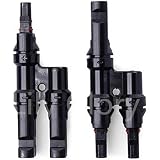
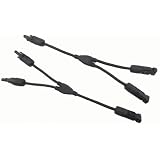
--If you do find that one of your panels is often shaded while the other isn't (I could see that happening when a pair is on opposite sides of the roof), then you can easily change them to parallel with the Y connectors (but you would want to up the wire size if you calculated it for series since you'd be changing to half the voltage and twice the amperage).
--One last note is that since you are running in series, you will want to be sure that everything you have between the panels and the controller is rated up to the maximum voltage on a cold morning (some switches and fuses might not be). Looking at your panels' specs, and running them through a calculator, I see that on, say, a 20º morning you could see 22.9 volts per panel, which would mean 45.8 volts to the controller. Oftentimes switches or etc. are only rated to 32 volts, so it's something to check. Also just to be aware that this is not a "safe and friendly" "just" 12 volt line, as you kind of learn to expect in our typical DC setups.
I used Morningstar's string calculator in case you are interested. They didn't have your exact Renogy panels listed (yet), but I had always suspected they were the same as the Grape panels I have (same smaller dimensions) just with slightly heavier glass. I checked the specs for my particular Grape panels and "bingo!" exactly the same (except for the weight, but we don't care about that for this calculation). I used 20ºF for the record low temp (no idea where you are located or where you might travel). The colder it gets overnight, the more voltage the controller will see at the moment they start up in the morning.
Link to the calculator:
http://string-calculator.morningstarcorp.com/
Panel info I used (same panels from what I can see):
Brand: Grape
Model: GS-S-100-TS
With the above info you can play with temps in the calculator if you have a different temp scenario than I guessed at.
Nothing like the first few weeks of running along like a top on your own solar

I still marvel at it after more than a year. (Previously I have had "some" solar on boats and etc. but never ran a completely "normal" (for me) life on it before. Plus now there are LED's etc.