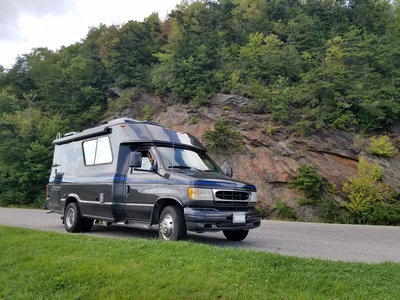
New guy in town
Re: New guy in town
Wonder what Blue did, he use to be a boater.... i think the marine grade plywood use like 10 layers pressed together versus the 4 or 5 regular plywood uses, i also think marine grade is almost immune to mold and mildew caused by these moisture issues.

Re: New guy in town
Physics-wise, I see what you are describing, but I don't think it would work in the Chinook as-built. Reason I say that is that the connection between the "bulkhead" walls and the outside walls of the Chinook is not very strong. Nothing like it would be in a boat, where typically that full edge would be fiberglass tabbed to the hull (i.e. outside wall) and be essentially bulletproof.
The Chinook bulkheads (at least in our era) are attached to the outside wall, but not in a very strong way. Essentially a strip of 1/2" plywood is casually glassed to the wall, and the bulkhead is screwed to that. So they do the job but kind of "just" and then the parts are greater than each one individually, if that makes sense, and is what keeps it all together. The bulkhead walls hold up the ceiling, the cabinets and fridge keep them from bowing, and they are screwed to the floor and to the outside wall. But none of those connections alone is very strong.
Are your plywood bulkhead walls damaged? Or do you want to do away with them for some reason? If just the lowest bit is damaged, you could scarf/glass in a new section. Or maybe you have some other design features you are wanting to pursue?
The Chinook bulkheads (at least in our era) are attached to the outside wall, but not in a very strong way. Essentially a strip of 1/2" plywood is casually glassed to the wall, and the bulkhead is screwed to that. So they do the job but kind of "just" and then the parts are greater than each one individually, if that makes sense, and is what keeps it all together. The bulkhead walls hold up the ceiling, the cabinets and fridge keep them from bowing, and they are screwed to the floor and to the outside wall. But none of those connections alone is very strong.
Are your plywood bulkhead walls damaged? Or do you want to do away with them for some reason? If just the lowest bit is damaged, you could scarf/glass in a new section. Or maybe you have some other design features you are wanting to pursue?
1999 Concourse
Re: New guy in town
mine is damaged from moisture at the bottom

Re: New guy in town
A question for those in the know. Is marine plywood pressure treated against rot? I had a boat many years ago and just don't remember.
FWIW I use Baltic Birch plywood for neck and heel blocks in guitar building and making jigs and the like and suspect its probably close to the same thing as it is extremely strong and stable with multiple thin layers.
FWIW I use Baltic Birch plywood for neck and heel blocks in guitar building and making jigs and the like and suspect its probably close to the same thing as it is extremely strong and stable with multiple thin layers.
Steve aka SMan
2004 Premier V10
2004 Premier V10
Re: New guy in town
Thanks the welcome and tips. The more I get into this thing the more apparent it becomes that this sat for a while with a leak. All of the cabinetry has water damage next to the floor. It extended up about a foot in the rear and 3-4 inches in the front. I have a several week trip coming up in about a week so for now I am going to fix the worst of it so I can get it back on the road. After I live with it for a while I'll decide how much I'm going to replace. I'm replacing all the MDF with plywood for a couple reasons. It's more resistant to damage if it does happen to get exposed to water and secondly it's lighter, which I wasn't aware this camper could use until I discovered this forum. I'm not going with marine grade because unless it gets damaged again it shouldn't need that kind of water resistance.
Thanks for the tip of removing the back panel in the spare tire locker. I don't need the MDF but making more room and eliminating more weight...win win!
I've found a couple of things in storage the previous owner left that I can't identify. I don't think they are anything I need but I though I would check to see if anyone recognizes them before they are pitched. One is a motor that has a square socket and runs maybe 5 RPM when plugged in (rotisserie motor?). The other is 2 black pieces of fairly heavy metal, bent slightly in the center and maybe 18 inches long. (picture attached)
Thanks for the tip of removing the back panel in the spare tire locker. I don't need the MDF but making more room and eliminating more weight...win win!
I've found a couple of things in storage the previous owner left that I can't identify. I don't think they are anything I need but I though I would check to see if anyone recognizes them before they are pitched. One is a motor that has a square socket and runs maybe 5 RPM when plugged in (rotisserie motor?). The other is 2 black pieces of fairly heavy metal, bent slightly in the center and maybe 18 inches long. (picture attached)
Rick
Cincinnati, Oh
98 Concourse
Cincinnati, Oh
98 Concourse
Re: New guy in town
I can't see the photos, although from the descriptions neither of the things ring a bell as stock Chinook items. The awning pole/operator rod are both aluminum, and the extended draw bar is black steel (but that's pretty obviously a trailer hitch part).
I don't believe marine plywood is pressure treated. I think it's made with specific glues/resins/etc. and also it is void free.
I am a proponent of marine plywood when using it in boat-building (vs. hundreds of hours of labor and then using "whatever" plywood), but I don't know that it's necessary in a Chinook. Not a problem to use it, if desired though.
I do agree that using a decent plywood is preferable to MDF, for the reasons you stated: Namely that it's lighter and that it doesn't puff up and die when you spill a teaspoon of water nearby. Doesn't help that it was sitting on carpet either. My Chinook had been stored indoors and had no signs of leaks from exterior vents, but the bottom thin pieces (where the hinges were) of the under fridge/stove/sink flip down doors were torn apart. from a combination of stress (because hinges), weak MDF, and maybe someone dripped a little water when working at the sink or some condensation dripped out of the fridge door after a trip. Now come on, THERE is where we could have used some of that heavy oak!
I removed the back panel of the "tire locker" to get a look at the black and grey tank vents (my black tank had not been used and I had read where one Chinook owner had found a few inches of vent pipe extending into the black tank thereby rendering it even smaller so I wanted to have a look-see before using it), and when I saw all that extra space I didn't put it back. Instead I got some foil faced 1/2" insulation and fashioned that into a back wall (pads the shower wall and of course insulates). Then I made a small two-sided cover at floor level (the other two sides are the floor and the shower wall) for the vent pipes so I could set things there without affecting them. Much more space and buh-bye 20# piece of MDF (I kept the side walls though because they cover up a LOT of stuff that I would not want in my storage area (wires, pipes, etc.).
When I had to suddenly stop my cabinetry remodeling project (my cabinetmaker discovered serious cancer), I found it was fairly easy to make things functional and strong with some cleats/screws/plywood/etc. On our years the floor is thick plywood, so no worries about screwing into coring or anything like that. Just be careful not to stress the outside walls - especially in the area of the refrigerator intake vent which is not as strong as continuous walls.
I don't believe marine plywood is pressure treated. I think it's made with specific glues/resins/etc. and also it is void free.
I am a proponent of marine plywood when using it in boat-building (vs. hundreds of hours of labor and then using "whatever" plywood), but I don't know that it's necessary in a Chinook. Not a problem to use it, if desired though.
I do agree that using a decent plywood is preferable to MDF, for the reasons you stated: Namely that it's lighter and that it doesn't puff up and die when you spill a teaspoon of water nearby. Doesn't help that it was sitting on carpet either. My Chinook had been stored indoors and had no signs of leaks from exterior vents, but the bottom thin pieces (where the hinges were) of the under fridge/stove/sink flip down doors were torn apart. from a combination of stress (because hinges), weak MDF, and maybe someone dripped a little water when working at the sink or some condensation dripped out of the fridge door after a trip. Now come on, THERE is where we could have used some of that heavy oak!
I removed the back panel of the "tire locker" to get a look at the black and grey tank vents (my black tank had not been used and I had read where one Chinook owner had found a few inches of vent pipe extending into the black tank thereby rendering it even smaller so I wanted to have a look-see before using it), and when I saw all that extra space I didn't put it back. Instead I got some foil faced 1/2" insulation and fashioned that into a back wall (pads the shower wall and of course insulates). Then I made a small two-sided cover at floor level (the other two sides are the floor and the shower wall) for the vent pipes so I could set things there without affecting them. Much more space and buh-bye 20# piece of MDF (I kept the side walls though because they cover up a LOT of stuff that I would not want in my storage area (wires, pipes, etc.).
When I had to suddenly stop my cabinetry remodeling project (my cabinetmaker discovered serious cancer), I found it was fairly easy to make things functional and strong with some cleats/screws/plywood/etc. On our years the floor is thick plywood, so no worries about screwing into coring or anything like that. Just be careful not to stress the outside walls - especially in the area of the refrigerator intake vent which is not as strong as continuous walls.
1999 Concourse

Re: New guy in town
Hi Rick,
It's great to see another Chinook getting restored. For a DIYer, it's well worth doing.
I had a hunch that there was a consistent leak over the course of a few years (judging from the staining in the lumber that you've shown). Look out for dryrot in the pieces that are real wood, especially the luan walls.
Not that this really affects your situation but, as we well know, MDF is heavy, weak, intolerant of water, etc. so it's easy to hate. But it's very flat and smooth so it takes the fake wood overlay nicely, it's dimensionally stable (key in RV cabinet carcasses), it machines nicely, and it's cheap. I wouldn't use it for most things, but just pointing out why coach builders like it for cabinets. I understand your decision to pass on marine grade or baltic birch because they would be overkill, however they're great materials when their particular properties are desired.
It's a smart decision to spend more time familiarizing yourself with the rig. You'll certainly learn how you want things. The number one priority IMO would be to find and fix any and all sources of water intrusion. Some can be well buried. I had a leak at the furnace intake/exhaust flange and I would have never known had I not removed my furnace. And that's a location where I really, really do not want dryrot in the floor (the coach bolts to the frame rails nearby). I also had a slow leak coming in through the passenger tail light. Wouldn't have caught that one either if I hadn't been tweaking the cabinet under the closet.
Have fun with the project, and hopefully the seller can reconcile some of your expenses.
It's great to see another Chinook getting restored. For a DIYer, it's well worth doing.
I had a hunch that there was a consistent leak over the course of a few years (judging from the staining in the lumber that you've shown). Look out for dryrot in the pieces that are real wood, especially the luan walls.
Not that this really affects your situation but, as we well know, MDF is heavy, weak, intolerant of water, etc. so it's easy to hate. But it's very flat and smooth so it takes the fake wood overlay nicely, it's dimensionally stable (key in RV cabinet carcasses), it machines nicely, and it's cheap. I wouldn't use it for most things, but just pointing out why coach builders like it for cabinets. I understand your decision to pass on marine grade or baltic birch because they would be overkill, however they're great materials when their particular properties are desired.
It's a smart decision to spend more time familiarizing yourself with the rig. You'll certainly learn how you want things. The number one priority IMO would be to find and fix any and all sources of water intrusion. Some can be well buried. I had a leak at the furnace intake/exhaust flange and I would have never known had I not removed my furnace. And that's a location where I really, really do not want dryrot in the floor (the coach bolts to the frame rails nearby). I also had a slow leak coming in through the passenger tail light. Wouldn't have caught that one either if I hadn't been tweaking the cabinet under the closet.
Have fun with the project, and hopefully the seller can reconcile some of your expenses.
1994 Premier
Re: New guy in town
Thanks Scott. Besides saving a bundle of $$, I do enjoy restoring this old stuff, especially when it's a quality product to start with. My sister is always telling me "busy hands are happy hands..." I do wonder about the age of the mechanicals, if you have a breakdown Murphy's law says it will probably be at the worst possible place. Plus I have one of those early V10's with the spark plug issue.
I've done lots of cabinet work and MDF does work really well for that, but it's not a material I would pick for an application that had any chance of getting wet. It's great to have this resource and lets me know of plenty of areas i wouldn't have suspected to keep and eye on.
Probably one of those problems between the chair and keyboard uploading the picture. I'll give it another try
I've done lots of cabinet work and MDF does work really well for that, but it's not a material I would pick for an application that had any chance of getting wet. It's great to have this resource and lets me know of plenty of areas i wouldn't have suspected to keep and eye on.
Probably one of those problems between the chair and keyboard uploading the picture. I'll give it another try
- Attachments
-
Rick
Cincinnati, Oh
98 Concourse
Cincinnati, Oh
98 Concourse
Re: New guy in town
Interesting. The angle brackets almost look like they could have to do with the couch, except I don't think they do. (Helpful, aren't I?).
If it makes you feel any better, I don't think any of the Ford vans ever got the "next" V-10. It actually had potential spark plug issues too, only instead of potentially blowing out, they got stuck inside.
When I was researching before buying my prior campervan (had the Triton engine also but the 5.4), the spark plug issue had me totally . I was used to Toyotas and such that just kept on rolling. But I went ahead with my purchase anyway (no Toyota, Volvo, or Honda campervans here), and I've been pleased. Now the Chinook is my second one, and I know of many people who haven't had issues (doesn't mean you won't of course).
The other thing that made me feel more confident is that there is a proven fix, which is to put in Time Serts (if I remember the name correctly - basically just inserts). I might even have them done ahead of time if going foreign or someplace remote. I did have my plugs changed when I bought the rig (even though only 49,000 miles), figuring maybe that would be a good thing.
The other issue I've heard of is that the exhaust manifold studs can corrode and break off (and of course with those huge banks on the V-10 there is probably plenty of stress as they cool/heat/etc.). Again a known problem that can be repaired, if it happens.
To the good, I've read of many "rode hard and put away wet" fleet V-10's that have gone to hundreds of thousands of miles. Most people don't get anything like that kind of mileage on an RV.
If it makes you feel any better, I don't think any of the Ford vans ever got the "next" V-10. It actually had potential spark plug issues too, only instead of potentially blowing out, they got stuck inside.
When I was researching before buying my prior campervan (had the Triton engine also but the 5.4), the spark plug issue had me totally
. I was used to Toyotas and such that just kept on rolling. But I went ahead with my purchase anyway (no Toyota, Volvo, or Honda campervans here), and I've been pleased. Now the Chinook is my second one, and I know of many people who haven't had issues (doesn't mean you won't of course).The other thing that made me feel more confident is that there is a proven fix, which is to put in Time Serts (if I remember the name correctly - basically just inserts). I might even have them done ahead of time if going foreign or someplace remote. I did have my plugs changed when I bought the rig (even though only 49,000 miles), figuring maybe that would be a good thing.
The other issue I've heard of is that the exhaust manifold studs can corrode and break off (and of course with those huge banks on the V-10 there is probably plenty of stress as they cool/heat/etc.). Again a known problem that can be repaired, if it happens.
To the good, I've read of many "rode hard and put away wet" fleet V-10's that have gone to hundreds of thousands of miles. Most people don't get anything like that kind of mileage on an RV.
1999 Concourse
Re: rgmullins
I recently returned from my first trip in the Chinook and mostly it went pretty well. While stuck in traffic in Atlanta I made the comment that some idiot was burning his brakes up. About 15 minutes later I figured out the idiot was me. I pulled up Google and found the closest Ford dealer was only 5 miles away. After explaining my situation to the service advisor, 5 minutes later my rig was on the rack and 3 hours later I was back on the road with new front calipers and a complete brake job. Because the Chinook is so short they were able to pull it right into the service bay. It was this kind of possible situation that kept me from buying a Sprinter Van. I'm sure in that case I would have at a minimum been spending the night there. But 2000 miles and 2 weeks later I'm pretty happy with my purchase, but I'm already planning a few mods, mostly storage realated.
- Attachments
-
-
Rick
Cincinnati, Oh
98 Concourse
Cincinnati, Oh
98 Concourse