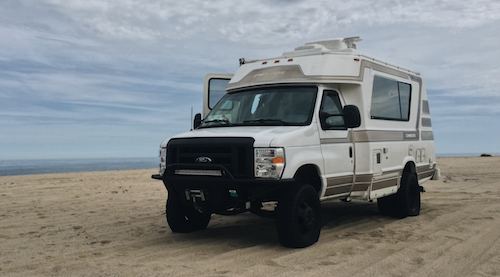
Could someone please start up a tire shop where they just do the job?caconcourse wrote: The villain was our local tire shop who failed to tighten the simulator locknut properly.
Deflating Tires for Unimproved Roads
Re: Deflating Tires for Unimproved Roads
1999 Concourse
Re: Deflating Tires for Unimproved Roads
Here is another comparison chart - this is for the larger compressors. As usual, click twice to make it more legible.
After more thought and comparing, I'm thinking the 400P-Automatic. It doesn't have some of the "RV" things that the 450-Automatic RV does -- but I'm not sure I need those, and the 400 will fill faster, which I think would be nice if holding the chuck (which you need to do for the automatic).
On the other hand, if I'm not going to air up/down, then I wouldn't need even the 400P-A. So will I ever do that? I'll have to give it some thought... On the other other hand, it's a nice piece of kit regardless. I'll probably choose it. Maybe. We'll see
After more thought and comparing, I'm thinking the 400P-Automatic. It doesn't have some of the "RV" things that the 450-Automatic RV does -- but I'm not sure I need those, and the 400 will fill faster, which I think would be nice if holding the chuck (which you need to do for the automatic).
On the other hand, if I'm not going to air up/down, then I wouldn't need even the 400P-A. So will I ever do that? I'll have to give it some thought... On the other other hand, it's a nice piece of kit regardless. I'll probably choose it. Maybe. We'll see
1999 Concourse
Re: Deflating Tires for Unimproved Roads
I know you're on the 12V track, and understandably. A mini 12V is what I carry, but it's only a cheap generic unit for emergency back up and topping off. I've torn the thing completely apart and it's a manufacturing disaster, but it works somehow. Anyway, the air hose thing is another advantage to the 120V hot dog type. You can use a short hose and bring the compressor to each tire by using an extension cord. 30 or 60 feet of hose is indeed a hassle, but more importantly, it's only used for one thing, and used only occasionally, if ever. Extension cords are useful for other things, and I always have at least one aboard.Blue~Go wrote: I think I can reach all of the Chinook tires with one 30' hose (and on my buddy's, the two hoses are a pain to stow because they get tangled, etc.).
Don't get me wrong, I wouldn't lug along a tank type compressor and bother with a generator, but if I was planning to air down like Paul is mentioning, then I'd sacrifice the space for a 120V with tank (if generator was along). They are certainly larger.
Another thing to consider in all of this is time to inflate. Topping off? That's quick and doesn't matter. Emergency? Well, you're just trying to get underway. But if you're adding 40 psi to 6 tires using a tiny compressor, that can take an excruciatingly long time.
1994 Premier
Re: Deflating Tires for Unimproved Roads
Comparing the Viair Large RV model to the Porter Cable CMB15 120v compressor. The Viair is 50% smaller and 2 pounds lighter. The Viair runs off the engine, the CMB15 runs off of the generator. The Viair has 1.8 CFM at 0 PSI, the CMB15 has 2 CFM at 90 PSI. The Viair cost twice as much. The Viair has a 12 month warranty, the CMB15 has a 36 month warranty.
It also has the advantages that Scott talked about above.
Re: Deflating Tires for Unimproved Roads
I saw the same specs, and I realize it's not a type-o on your part, but I'm curious about the 1.8 CFM at 0 psi. Zero psi means there's no pressure, so there's no resistance to flow, so that's the max displacement at max RPM. But that's not very helpful (unless we're talking about fansltg wrote:The Viair has 1.8 CFM at 0 PSI, the CMB15 has 2 CFM at 90 PSI.
For the CMB15, 2 cfm at 90 psi looks pretty good. Nice machine for a hundred bucks.
Just for reference:
My little junker is rated 1 cfm at 40 psi and 0.6 cfm at 90 psi. It takes forever and is basically only useful for topping up.
By comparison, my 5hp shop compressor is rated 8.2 cfm at 40 psi and 5.6 cfm at 90 psi. It's quick, and will run basically any pneumatic tool with plenty of headroom.
1994 Premier
Re: Deflating Tires for Unimproved Roads
The Viair is rated at .97 cfm at 90 psi. Less than half the CMB15. In my way of thinking, the only decision is whether there is an onboard generator and the space to store the compressor. I have the storage space, a generator, and an invertor that can power the compressor. I run 65 psi in the front tires and 80 in the rear tires. With seasonal temperature changes and the small amount of pressure loss in storage, I can top off the tires in minutes. Once the compressor starts and airs up the air tank to 150 psi, it only runs a couple of minutes more while topping off all six tires.
Re: Deflating Tires for Unimproved Roads
Just as a note: I'm not sure why, but the Viair 450P-RV is rated at a much lower rate than the 400P. Maybe it has something to do with the fact that it's meant to air up truly large RV tires; or maybe it's because it can be used to blow out plumbing lines (?). I don't know, but just mention it because you don't expect the top model to output less. That's why I'm thinking about the 400P-A. I think the Automatic sounds nice (more like onboard air), but I don't want to have to hold the trigger any longer than necessary, and the 400 is faster.
I don't think I want onboard air (?). Maybe there are reasons I'm overlooking, but I'm thinking it sounds nice to have it be portable. Bring it to/along with another vehicle, throw it in my car when I go further afield, etc. Obviously this doesn't apply if you are using the onboard air for some function that is integral to Chinook operation.
1999 Concourse
Re: Deflating Tires for Unimproved Roads
I agree. I also think portable is better. The Glacier has an onboard compressor that inflates the slide bladder, but I have never tried to use it to air up tires. Maybe someone with a Glacier has tried that and can provide some information on that usage.
Re: Deflating Tires for Unimproved Roads
I'll be just topping up tire pressure. First was thinking on-board air but switched to thinking portable for same reasons Blue mentions. Storage size is a consideration too. While I like the CMB15 specs, I dont want to dedicate the require storage space.
I'll likely invest in the VIAIR 440P.
Last edited by b6fischer on March 29th, 2018, 10:03 am, edited 1 time in total.
1997 Chinook Concourse, over 200,000 Miles
Re: Deflating Tires for Unimproved Roads
My buddy with the Viair 450P-RV did have an AC compressor prior to this. He full times, so he's never just keeping it in the garage and plugging in to an outlet, but that wasn't the main reason for switching, because he has a 2000 watt whole house inverter/charger (although he did then have to go in, turn it on, remember to turn it off, etc.). The main reason was that the AC one he had was quite a bit larger and didn't fit well in his particular Class C's storage compartments. And too, he towed a car and hence wasn't able to just bring it along in the car if going on a backroads explor-a-thon. The DC one is smaller and can be toted along as long as you have a vehicle with a battery. He could very likely have gone with a smaller model; he's the type who hates to research so just buys the "best" one to avoid having to.
That's not to say the AC one or the onboard don't have their merits (Scott and others highlighted some of them). Just depends on preference, use-case, etc. At least for me, when I'm trying to decide how to go, I do appreciate hearing various people's reasoning for choosing one or the other, and then I can see which one seems to fit my situation. (Heck, maybe I will finally choose and buy one!)
1999 Concourse