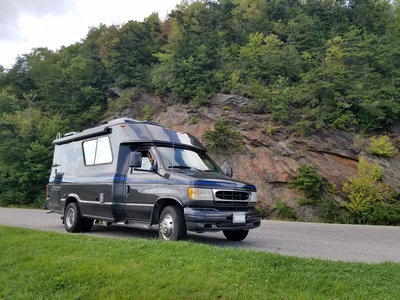
Has anyone put Super Dually's on their Chinook, or know anyone that has? If so how did you like them?
Dually's I've heard can be problematic off-road and super dually's might be solution.
Super dually's on Chinook
Super dually's on Chinook
2001 Concourse XL Lounge model, 6.8L Ford E350 Triton V-10 Chassis.
Re: Super dually's on Chinook
I'll bite... What are Super Duallys??
1998 Concourse V-10 Triton....AKA...Land Shark
Re: Super dually's on Chinook
They are one wide wheel/tire specifically made to replace a duallies two tires (rear wheel of Chinook). Since dually's are not known to be off-road friendly the super dually (single wide tire) is supposed to answer the problem of getting stuck off-road or ruining tires by getting rocks wedged between the two back tires.
Duallies are really not made for off-road, they excel in other others but not that.
2001 Concourse XL Lounge model, 6.8L Ford E350 Triton V-10 Chassis.
Re: Super dually's on Chinook
Thanks for clearing that up for me. I thought maybe it was going to be some type stabilizer.
1998 Concourse V-10 Triton....AKA...Land Shark

Re: Super dually's on Chinook
I've heard them described as Super Singles. The one immediate question that comes to mind is how can you fit two spare tires on most normal vehicles - a spare for the front tires, and a (very large) spare for the super singles in the rear. Depending on whether the rear hubs change, I suppose you could carry two "front" spares and then use them both on the rear, but even that sounds unwieldy.
I agree that single rear tires would be nice though - I'm not a huge fan of duallies; it's more like they are just a necessary evil.
I agree that single rear tires would be nice though - I'm not a huge fan of duallies; it's more like they are just a necessary evil.
1999 Concourse
Re: Super dually's (Super Singles) on Chinook
Like Blue, I think I've usually heard them referred to as "Super Singles tires".
For 4x4 they allow the rear tires to drive through the same path as the front, which sometimes is a real advantage (if the front can get through somewhere, the rear can too). And since with standard dually tires the 2 tires on each side on the rear are generally supposed to share the load, if you're driving somewhere off-road and there is only purchase for the outer (or inner) tire on one side, that tire may now be taking on more weight than it is rated for (especially if the vehicle is inclined to that side at that moment).
On the other hand, if you have a flat on the rear single and it goes flat fast, the rear of an RV is heavy and could damage that side underneath, and will almost certainly shred the single tire, which can then also mess up the fiberglass wheel-well. With dual rear tires, the most damage you'd usually get is if the tread comes off one of the tires and chews up the back of the wheel well (my Concourse has the passenger rear wheel-well fiberglass messed up, possibly from a flat before I bought it). But at least you might still be able to limp to a service station, and most likely the back-end won't drop and hurt suspension or tanks or anything else.
And the Super Single tires are heavier, and harder to change in the field. At least, that is what some forums seem to suggest.
I think if I were going to Super Singles, I'd use them on front and back (both for using the same spare, and to keep the front and rear tire paths identical in width, which to me is one of the reasons for going single in the first place). But only if getting a 4"-8" lift, and probably 4x4.
Everything is always a trade-off.
Bob
For 4x4 they allow the rear tires to drive through the same path as the front, which sometimes is a real advantage (if the front can get through somewhere, the rear can too). And since with standard dually tires the 2 tires on each side on the rear are generally supposed to share the load, if you're driving somewhere off-road and there is only purchase for the outer (or inner) tire on one side, that tire may now be taking on more weight than it is rated for (especially if the vehicle is inclined to that side at that moment).
On the other hand, if you have a flat on the rear single and it goes flat fast, the rear of an RV is heavy and could damage that side underneath, and will almost certainly shred the single tire, which can then also mess up the fiberglass wheel-well. With dual rear tires, the most damage you'd usually get is if the tread comes off one of the tires and chews up the back of the wheel well (my Concourse has the passenger rear wheel-well fiberglass messed up, possibly from a flat before I bought it). But at least you might still be able to limp to a service station, and most likely the back-end won't drop and hurt suspension or tanks or anything else.
And the Super Single tires are heavier, and harder to change in the field. At least, that is what some forums seem to suggest.
I think if I were going to Super Singles, I'd use them on front and back (both for using the same spare, and to keep the front and rear tire paths identical in width, which to me is one of the reasons for going single in the first place). But only if getting a 4"-8" lift, and probably 4x4.
Everything is always a trade-off.
Bob

Re: Super dually's on Chinook
I haven't tried super singles, but for my situation, I think I'll avoid them. I do mostly boondocking in the desert (Moab, etc.). I can see the advantage of having more off road ability however one major hesitation will keep me from ever switching to singles.
I had a rear blowout at 70 mph on the interstate in Utah near Zion NP. It was loud, jarring and scary but we were able to smoothly coast to the shoulder and come to a controlled stop to figure out what happened. We were then forced to limp on the remaining tire (for reasons I'm not going to explain in this thread) for an additional 10 miles to go find a suitable replacement. If we didn't have the dual rear tires things could have been drastically different. If I could have dual tires on the front axle as well, I would.
I do my fair share of off road driving, but realistically, mile for mile, 99% of the odometer shows highway driving. For my family, having the dually is a safety thing.
I had a rear blowout at 70 mph on the interstate in Utah near Zion NP. It was loud, jarring and scary but we were able to smoothly coast to the shoulder and come to a controlled stop to figure out what happened. We were then forced to limp on the remaining tire (for reasons I'm not going to explain in this thread) for an additional 10 miles to go find a suitable replacement. If we didn't have the dual rear tires things could have been drastically different. If I could have dual tires on the front axle as well, I would.
I do my fair share of off road driving, but realistically, mile for mile, 99% of the odometer shows highway driving. For my family, having the dually is a safety thing.
"Harvey the RV" - 1994 Chinook Premier, Dinette, 7.5L V8
-
pdemarest
- **Forum Contributor**
- Posts: 384
- Joined: August 8th, 2015, 11:54 am
- Location: Santa Cruz, CA
Re: Super dually's on Chinook
I'm also a fan of duallies now that I have a Chinook. They seem to provide more stability in cornering and have more traction than singles. Today we drove almost 20 miles up and back a rock and gravel road with lots of steep grades and I never felt the RV slip even once. If I had been driving my other vehicle - a Navigator - I know that the rear wheels would be slipping unless I was in 4 wheel drive.
Paul Demarest
2003 Premier V-10
2003 Premier V-10
Re: Super dually's on Chinook
My understanding is that they are mostly for semi trucks and most RV does not take advantage of it because it is more dangerous. Most truckers prefer not to deal with it, and it is not a economical alternative either.
2000 Concourse dinette, on 1999 6.8L Ford E350 Triton V-10 Chassis