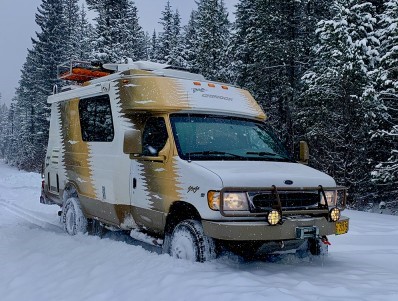
My 2000 model Concourse has started blistering in some spots over the paint stripes... mainly the front where it says Chinook and in the slope above the storage area behind the spare tire. Is there an easy fix? Spray gel coat or anything...I have small problem now but I don't want it to get bigger! Thanks in advance for any info!
Chris
Howe do you stop clear coat blistering?

Re: Howe do you stop clear coat blistering?
I've never seen actual "blisters," but it is not uncommon for the clearcoat (which is over the painted areas) to flake and peel. It's similar to what you see on some cars from sunny climates (looks whitish on dark cars). So I'll for now presume you have something like that going on. The only way I know of to stop it is to not have any UV rays touch it (i.e. never take it outside). Obviously not totally practical for a camper!
A good wax (such as Collinite 885 Fleetwax) will have UV inhibitors, and you can cover or garage it when not in use.
Once it has started to flake you can either live with it, attempt a DIY repair*, or have the stripes re-painted (or the whole thing re-painted in any way you like, but only the stripes have clearcoat originally; the white is just gelcoat and can be buffed out if it gets dull).
*There are a few threads on this, but basically you veeeery carefully feather the edges of the peeling clearcoat, and then spray with rattle can clearcoat. Probably no pro's will do this as it's not really the correct way (so fair enough), but you may prefer it to doing nothing, and it can even look pretty good.
A good wax (such as Collinite 885 Fleetwax) will have UV inhibitors, and you can cover or garage it when not in use.
Once it has started to flake you can either live with it, attempt a DIY repair*, or have the stripes re-painted (or the whole thing re-painted in any way you like, but only the stripes have clearcoat originally; the white is just gelcoat and can be buffed out if it gets dull).
*There are a few threads on this, but basically you veeeery carefully feather the edges of the peeling clearcoat, and then spray with rattle can clearcoat. Probably no pro's will do this as it's not really the correct way (so fair enough), but you may prefer it to doing nothing, and it can even look pretty good.
1999 Concourse
Re: Howe do you stop clear coat blistering?
PS: Just to clarify, on a 2000 Concourse you have essentially two different surfaces.
First of all, the entire shell is made of molded fiberglass. Polyester gelcoat is sprayed into the mold first, in this case in a white color. Then the shell is made of reinforced fiberglass. So that shiny (or dull) white surface you see on most of the rig is just the white gelcoat. This is not paint. It starts out really shiny, and over time and UV exposure can get chalky and dull. It can be sanded/buffed/compounded in various combinations to bring the shine back (by removing a thin "dead" layer of gelcoat). Then you can wax to protect it somewhat from UV.
So if they stopped there you'd have an all white Chinook. But they did various treatments for the various models. In 2000, the Premiers got vinyl sticker type stripes and graphics. The Concourses got the "racing stripe" livery which was automotive paint sprayed on (the colors), and then overcoated with automotive clear coat. These are both paint products (or, if you will, "coatings").
With the gelcoated fiberglass (the white), you can repair chips and damaged areas with fiberglass (for larger repairs) and gelcoat. Or, if just dull, you can compound/buff.
On the painted areas, the "right" way is to just sand them down and re-paint. There is no official "proper" way to partially fix clearcoat. But as mentioned above, some DIY-ers here have carefully spot repaired. You wouldn't use any gelcoat here, because the paint/clearcoat are not resin, but paint.
The later "Millenium" (swoopy) paint jobs (on both Premiers and Concourses) are, I believe, also paint and clearcoat (with the white areas being gelcoat background, like the earlier years). I haven't seen them with deteriorating clearcoat. I suspect that is a combination of three things: One, they are newer (so less time for UV exposure); two, on cars, newer clearcoat seems longer lasting - probably formulations improved; and, three, I notice they no longer put colored stripes and such on things like the horizontal cabover area (or to a lesser degree). Not sure if that was plan or happenstance.
The vinyl stickered Premiers can be fixed by removing the stripes (which crack and fade) with something like a 3M "Stripe-off" wheel and then having new stickers made (or painting). Somewhat ironic that the "lower" model is now easier/cheaper to fix in that way.
I have a soft spot for the racing stripe livery - plus I found a cream puff in the right place at the right time - so I decided I'd enjoy mine and then when it flakes, maybe have it re-painted. Or maybe just consider it the patina of age and adventures
First of all, the entire shell is made of molded fiberglass. Polyester gelcoat is sprayed into the mold first, in this case in a white color. Then the shell is made of reinforced fiberglass. So that shiny (or dull) white surface you see on most of the rig is just the white gelcoat. This is not paint. It starts out really shiny, and over time and UV exposure can get chalky and dull. It can be sanded/buffed/compounded in various combinations to bring the shine back (by removing a thin "dead" layer of gelcoat). Then you can wax to protect it somewhat from UV.
So if they stopped there you'd have an all white Chinook. But they did various treatments for the various models. In 2000, the Premiers got vinyl sticker type stripes and graphics. The Concourses got the "racing stripe" livery which was automotive paint sprayed on (the colors), and then overcoated with automotive clear coat. These are both paint products (or, if you will, "coatings").
With the gelcoated fiberglass (the white), you can repair chips and damaged areas with fiberglass (for larger repairs) and gelcoat. Or, if just dull, you can compound/buff.
On the painted areas, the "right" way is to just sand them down and re-paint. There is no official "proper" way to partially fix clearcoat. But as mentioned above, some DIY-ers here have carefully spot repaired. You wouldn't use any gelcoat here, because the paint/clearcoat are not resin, but paint.
The later "Millenium" (swoopy) paint jobs (on both Premiers and Concourses) are, I believe, also paint and clearcoat (with the white areas being gelcoat background, like the earlier years). I haven't seen them with deteriorating clearcoat. I suspect that is a combination of three things: One, they are newer (so less time for UV exposure); two, on cars, newer clearcoat seems longer lasting - probably formulations improved; and, three, I notice they no longer put colored stripes and such on things like the horizontal cabover area (or to a lesser degree). Not sure if that was plan or happenstance.
The vinyl stickered Premiers can be fixed by removing the stripes (which crack and fade) with something like a 3M "Stripe-off" wheel and then having new stickers made (or painting). Somewhat ironic that the "lower" model is now easier/cheaper to fix in that way.
I have a soft spot for the racing stripe livery - plus I found a cream puff in the right place at the right time - so I decided I'd enjoy mine and then when it flakes, maybe have it re-painted. Or maybe just consider it the patina of age and adventures
1999 Concourse