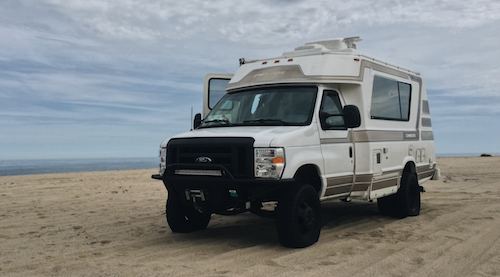
Good morning all, I hope everyone had a good end to the year and a great start to the new one.
As will become obvious I am not a wizard on electricity, however as I have been researching and trying to design the best system for my project it all seems to fit into 3 separate systems, however they do "touch" each other.
1. 12 volt "Ford" system. The stuff that came from Ford (or Chevy) that makes the engine run, brake lights, etc.
Don't plan on changing much here other than heaver cables (thanks BG).
2. 12 volt Chinook" system. These are the things in the living area that will be battery powered. LED lights, chest type ref., charging stations, entertainment stuff. This will be charged by the Ctek system (uses my 200 amp. alternator and has a built in mppt solar input) and some portable solar panels.
3. 110 volt system. This will be powered by shore power. Includes Air Con, resistance heater, Chest ref.(it switches automatically), smart battery charger for the leisure batteries, a number of duplex outlets. This means that in extreme temps., we would consider a campground. We will however be chasing 70.
Based on our usage history I don't think I need an inverter (other than a small plug in one).
I would appreciate input from anyone.
Thanks in advance.
3 electrical systems
3 electrical systems
Riste
1997 Concourse 460
1997 Concourse 460

Re: 3 electrical systems
Happy New Year, Riste!
You have the basic idea just exactly right. And now you know why even tiny RV's are so complicated. Even a large house doesn't have the same "layering" of systems. Also, I think that even though you aren't experienced, learning about it is a really good idea. Go you. That's because it can be very hard to find a knowledgeable tech (and if you don't already know the systems, you often can't tell if the tech is knowledgeable or not).
OTOH, once you know your system and how to do (and figure out) the basics -- plus invest in some good tools -- then you are free to do and change as you see fit (and you may find you want to change things as new tech comes out or your usage pattern is honed or changed).
A couple of comments:
1) Much heavier cable AND FUSING on BOTH ends on the combiner line (including the negative spur from the Ford start battery to the grounding point and the negative spur from the house bank to the frame).
2) My year had a ridiculous "illuminated entry" system for the dome light that the owner could not control (people love you at star parties....not). I changed around the wiring so I could control the dome lights (imagine that).
3) I removed the Beverage Mate console and may re-use that wiring for an outlet.
I think that's all I've done. #1 is very important and the rest is mostly just fun stuff.
Interesting about combining the B2B charger and a solar controller. I think I was just reading about a similar device recently (forget the details though). I would want to make sure the solar controller part was top notch, for two reasons. One is that solar is charging often (so it matters), and two is that excellent stand alone solar controllers are not that expensive (especially for smaller systems). I have found the devil is in the details with chargers.
Also note that this system can also be charged by being plugged in to shore power and/or generator if you have one. You do mention that below, but it kind of overlaps into this system (as you mentioned earlier).
I think not just "automatically" putting in a big inverter is wise. That doesn't mean you shouldn't ever do so, but for many people it's not needed. Just depends on you. I have been just fine with only a 75 watt "cigarette plug" one for years. I charge my toothbrush battery with it. Pretty much everything else is straight DC with no inverter needed (power tool battery charger, computer, AA and AAA battery charger, etc.)
So yep, I think you have the basic idea down just fine. I can't remember your exact usage scenario (I'm sorry if you have mentioned it and I forgot), but so far it sounds somewhat like mine. Anyway, the main thing is to realize that there are different ones and tailor your system accordingly (because, as usual, there is no one best system - there is only the best system for a certain use case, and of course there is a "proper" system in terms of safety, but that applies to all setups.
You have the basic idea just exactly right. And now you know why even tiny RV's are so complicated. Even a large house doesn't have the same "layering" of systems. Also, I think that even though you aren't experienced, learning about it is a really good idea. Go you. That's because it can be very hard to find a knowledgeable tech (and if you don't already know the systems, you often can't tell if the tech is knowledgeable or not).
OTOH, once you know your system and how to do (and figure out) the basics -- plus invest in some good tools -- then you are free to do and change as you see fit (and you may find you want to change things as new tech comes out or your usage pattern is honed or changed).
A couple of comments:
I agree there. The only changes I've made to the Ford system are as follows:Riste wrote: January 1st, 2019, 5:59 am
1. 12 volt "Ford" system. The stuff that came from Ford (or Chevy) that makes the engine run, brake lights, etc.
Don't plan on changing much here other than heaver cables.
1) Much heavier cable AND FUSING on BOTH ends on the combiner line (including the negative spur from the Ford start battery to the grounding point and the negative spur from the house bank to the frame).
2) My year had a ridiculous "illuminated entry" system for the dome light that the owner could not control (people love you at star parties....not). I changed around the wiring so I could control the dome lights (imagine that).
3) I removed the Beverage Mate console and may re-use that wiring for an outlet.
I think that's all I've done. #1 is very important and the rest is mostly just fun stuff.
Do tell about your alternator. I thought the standard one for our cutaways was 150 or 160 amps. (Oh wait, you have the 460 - maybe they got a larger alternator?)Riste wrote: January 1st, 2019, 5:59 am2. 12 volt Chinook" system. These are the things in the living area that will be battery powered. LED lights, chest type ref., charging stations, entertainment stuff. This will be charged by the Ctek system (uses my 200 amp. alternator and has a built in mppt solar input) and some portable solar panels.
Interesting about combining the B2B charger and a solar controller. I think I was just reading about a similar device recently (forget the details though). I would want to make sure the solar controller part was top notch, for two reasons. One is that solar is charging often (so it matters), and two is that excellent stand alone solar controllers are not that expensive (especially for smaller systems). I have found the devil is in the details with chargers.
Also note that this system can also be charged by being plugged in to shore power and/or generator if you have one. You do mention that below, but it kind of overlaps into this system (as you mentioned earlier).
This is a good summary. I am using a similar refrigerator right now ("cooler shaped" compressor refrigerator) and it does the same. Works well. The main reason I'm looking forward to putting my "real" refrigerator in is to have a freezer and refrig. both. My chest one can be one or the other but not both. Carrying one or two small electric heaters is a good idea. I plug in about once a year and yet I still carry them just for those times.Riste wrote: January 1st, 2019, 5:59 am3. 110 volt system. This will be powered by shore power. Includes Air Con, resistance heater, Chest ref.(it switches automatically), smart battery charger for the leisure batteries, a number of duplex outlets. This means that in extreme temps., we would consider a campground. We will however be chasing 70.
Based on our usage history I don't think I need an inverter (other than a small plug in one).
I think not just "automatically" putting in a big inverter is wise. That doesn't mean you shouldn't ever do so, but for many people it's not needed. Just depends on you. I have been just fine with only a 75 watt "cigarette plug" one for years. I charge my toothbrush battery with it. Pretty much everything else is straight DC with no inverter needed (power tool battery charger, computer, AA and AAA battery charger, etc.)
So yep, I think you have the basic idea down just fine. I can't remember your exact usage scenario (I'm sorry if you have mentioned it and I forgot), but so far it sounds somewhat like mine. Anyway, the main thing is to realize that there are different ones and tailor your system accordingly (because, as usual, there is no one best system - there is only the best system for a certain use case, and of course there is a "proper" system in terms of safety, but that applies to all setups.
1999 Concourse

Re: 3 electrical systems
Blue posted while I was typing, but here's this anyway ... 
Is your house battery under the hood? If so, check the red 12v+ lead that goes to the load center. It runs directly past the driver side exhaust manifold. It might be a bit melty and should be moved away from the heat source. Also since you have a 460, if it's convenient for you or someone else, have a look at the wire that terminates at the starter solenoid. Mine was rubbing against the sharp edge of the motor mount; that's a very heavy gauge un-fused wire going directly to your battery and could lead to an unscheduled welding experiment.
As far as your other stuff, I would lazily say that it all comes down to personal preference. As a fourth "system" I would consider the generator because that can be used for more pressing needs like emergency roadside air con for a pet versus just plugging in a toaster at a campground. Or it can be completely eliminated and then you get a garage out of the deal. Hope that makes sense. Once adapted, it's not really enduring to live entirely off of 12v, especially when you're just going on trips (vs. living full time).
The decision to get an inverter or not shouldn't be that much of a head scratcher (not directed at you, but just saying). A quality pure sine 2000w unit can be had for under $200, and they're not terribly difficult to install depending on the setup. If you think you'd use one, go for it. I have one, and I never use it other than to power my AC fridge, so I should probably pipe down on that subject. For rarely used AC power tools, I just use a generator.
Hmm what else. If you get by with a chest fridge, then that's great. I hear they're quite efficient. We take extended trips and we cook a lot, so 4 cubic feet was the bare minimum, and I wanted a front facing door, so a chest was out. <---- See, personal preference.
With use and experience, I learned a lot about what I wanted and what I needed, and it turned out that I use way less than originally predicted.
Have fun chasing 70! (I'm typing in 36).
Is your house battery under the hood? If so, check the red 12v+ lead that goes to the load center. It runs directly past the driver side exhaust manifold. It might be a bit melty and should be moved away from the heat source. Also since you have a 460, if it's convenient for you or someone else, have a look at the wire that terminates at the starter solenoid. Mine was rubbing against the sharp edge of the motor mount; that's a very heavy gauge un-fused wire going directly to your battery and could lead to an unscheduled welding experiment.
As far as your other stuff, I would lazily say that it all comes down to personal preference. As a fourth "system" I would consider the generator because that can be used for more pressing needs like emergency roadside air con for a pet versus just plugging in a toaster at a campground. Or it can be completely eliminated and then you get a garage out of the deal. Hope that makes sense. Once adapted, it's not really enduring to live entirely off of 12v, especially when you're just going on trips (vs. living full time).
The decision to get an inverter or not shouldn't be that much of a head scratcher (not directed at you, but just saying). A quality pure sine 2000w unit can be had for under $200, and they're not terribly difficult to install depending on the setup. If you think you'd use one, go for it. I have one, and I never use it other than to power my AC fridge, so I should probably pipe down on that subject. For rarely used AC power tools, I just use a generator.
Hmm what else. If you get by with a chest fridge, then that's great. I hear they're quite efficient. We take extended trips and we cook a lot, so 4 cubic feet was the bare minimum, and I wanted a front facing door, so a chest was out. <---- See, personal preference.
With use and experience, I learned a lot about what I wanted and what I needed, and it turned out that I use way less than originally predicted.
Have fun chasing 70! (I'm typing in 36).
1994 Premier
Re: 3 electrical systems
Thanks guys,
Currently the house battery (a huge 65 amp hrs) lives under the hood with the assortment of relays, breakers, etc. I am removing the generator this week and that area will be the new battery home (room for up to 4 at 6 volts).I will be making the box smaller ( in the direction of the hall way). This will give me more closet. Now I end up with some extra space under the hood.
The only wire coming from the front will be a positive from the starter battery feeding into my charging system (to be located near the sink), all of the relays are part of the ctek. The batteries in the generator box also feed into a different terminal, as does solar. I was going to go around the back but after reading a number of posts suggesting under the coach I need to reconsider.
This set up (my alternator was frozen when I bought the Chinook so I had them upgrade to a 200 amp unit) is capable of charging at up to 140 amps.
Currently the house battery (a huge 65 amp hrs) lives under the hood with the assortment of relays, breakers, etc. I am removing the generator this week and that area will be the new battery home (room for up to 4 at 6 volts).I will be making the box smaller ( in the direction of the hall way). This will give me more closet. Now I end up with some extra space under the hood.
The only wire coming from the front will be a positive from the starter battery feeding into my charging system (to be located near the sink), all of the relays are part of the ctek. The batteries in the generator box also feed into a different terminal, as does solar. I was going to go around the back but after reading a number of posts suggesting under the coach I need to reconsider.
This set up (my alternator was frozen when I bought the Chinook so I had them upgrade to a 200 amp unit) is capable of charging at up to 140 amps.
Riste
1997 Concourse 460
1997 Concourse 460
Re: 3 electrical systems
Ooh, that's a big 32.5 usable amp hours (in a typical 50% draw down plan). What will you do with all that power?! Actually, my Chinook came to me with one wee Group 27 flooded cell in the house compartment (original grandpa owner had rig in storage, batteries of course aged out, grandchildren selling rig put in bare minimum; fine by me as I knew I'd be changing it all out anyway). I did get by for quite a while just using LED lights and minimal DC "device" charging when parked (and charging all the things when driving). I didn't have an electric fridge then of course. Also I wasn't worried about treating the battery well for a long life. But it worked for the duration while I worked up my improved system.
Aha, now I understand the alternator size.
With the combiner (big) cables, any reasonable steps you can take to make them "less long" will be beneficial. OTOH, longer just means bigger, more expensive, and heavier -- but in some situations that might trump a trickier routing that saves a few feet.
The other thing with the combiner wire is, do you plan to have the self-jump-start option? That may affect your fusing. At least on my setup, the starter amp draw is quite a bit higher than any charging amps that flow through the system, so I needed to fuse and size the wire for that as well as for voltage drop.
I used 1/0AWG wire and was able to have reasonable voltage drop, and also safe fusing. 2/0 would have been even better but you have to draw the line somewhere. 2/0 would have been tricky to fit where it crosses the air filter to get to the other side of the engine bay.
My run is likely shorter than yours will be, because my batteries are under the couch (start batt is on passenger side, then across along hood rear seam line, down under near steering column, and along driver's side frame rail and then up into coach for house bank). If I remember correctly, my run is around 16' -18' or so. Longer run equals either thicker wire or more voltage drop if thinner wire. 12 volt systems are a bit of a kick there, because the lower the voltage the higher the amperage (the more the voltage drop). But for now, most vehicles are 12-volt so that's what we usually work with. Longer wire equals more voltage drop or thicker wire to compensate.
A friend wanted to run only the barest of bare minimums for the combiner wire, and used 2AWG wire. He had to invoke a few "allowed but not ideal" exceptions to get to a fuse size that would both protect the wire and allow the needed amps through (just). And there was more voltage drop than you might ideally want. Not ideal, but then he also didn't use the combine function on any regular basis. And it was still better than the stock set up (this was not a Chinook but similar setup) which was not fused at all for the same reason the Chinook setup is not fused: The small stock wire size means that any fuse that was small enough to protect the wire would instantly blow in use, namely when jump starting. Also though, his run was even shorter (maybe 14' or so?)
I've only used the self-jump feature once, but it was handy. In my case it was nothing extra to do since I already was running wire plenty large enough to fuse for starting, just to keep the voltage drop down.
Maybe you have this all figured out already, but if not and if you want to discuss here, you could take a thick rope (or garden hose) and run the route you plan to run with your positive combiner wire, making sure to take into account all necessary twist and turns, runs to any fusing, switches, combiners, etc. Then post the length and we can calculate. Also know your starter amp draw (not sure if it's the same as the V10?). Also, have you mentioned what type of house bank you plan to install? That can have a bearing on how much charging power will go from your alternator to the bank (different types of batteries have different acceptance rates).
Also, if the combiner is also the solar controller, you are going to want to put it as close as you can to the house battery bank. Especially if you are planning any panels over nominal 12 volts. For the combiner function it usually doesn't matter where it goes along the line from start to house bank, but for solar it does (close as possible to house bank).
Hmm, maybe this should be a different thread?
Actually, my Chinook came to me with one wee Group 27 flooded cell in the house compartment (original grandpa owner had rig in storage, batteries of course aged out, grandchildren selling rig put in bare minimum; fine by me as I knew I'd be changing it all out anyway). I did get by for quite a while just using LED lights and minimal DC "device" charging when parked (and charging all the things when driving). I didn't have an electric fridge then of course. Also I wasn't worried about treating the battery well for a long life. But it worked for the duration while I worked up my improved system.Aha, now I understand the alternator size.
With the combiner (big) cables, any reasonable steps you can take to make them "less long" will be beneficial. OTOH, longer just means bigger, more expensive, and heavier -- but in some situations that might trump a trickier routing that saves a few feet.
The other thing with the combiner wire is, do you plan to have the self-jump-start option? That may affect your fusing. At least on my setup, the starter amp draw is quite a bit higher than any charging amps that flow through the system, so I needed to fuse and size the wire for that as well as for voltage drop.
I used 1/0AWG wire and was able to have reasonable voltage drop, and also safe fusing. 2/0 would have been even better but you have to draw the line somewhere. 2/0 would have been tricky to fit where it crosses the air filter to get to the other side of the engine bay.
My run is likely shorter than yours will be, because my batteries are under the couch (start batt is on passenger side, then across along hood rear seam line, down under near steering column, and along driver's side frame rail and then up into coach for house bank). If I remember correctly, my run is around 16' -18' or so. Longer run equals either thicker wire or more voltage drop if thinner wire. 12 volt systems are a bit of a kick there, because the lower the voltage the higher the amperage (the more the voltage drop). But for now, most vehicles are 12-volt so that's what we usually work with. Longer wire equals more voltage drop or thicker wire to compensate.
A friend wanted to run only the barest of bare minimums for the combiner wire, and used 2AWG wire. He had to invoke a few "allowed but not ideal" exceptions to get to a fuse size that would both protect the wire and allow the needed amps through (just). And there was more voltage drop than you might ideally want. Not ideal, but then he also didn't use the combine function on any regular basis. And it was still better than the stock set up (this was not a Chinook but similar setup) which was not fused at all for the same reason the Chinook setup is not fused: The small stock wire size means that any fuse that was small enough to protect the wire would instantly blow in use, namely when jump starting. Also though, his run was even shorter (maybe 14' or so?)
I've only used the self-jump feature once, but it was handy. In my case it was nothing extra to do since I already was running wire plenty large enough to fuse for starting, just to keep the voltage drop down.
Maybe you have this all figured out already, but if not and if you want to discuss here, you could take a thick rope (or garden hose) and run the route you plan to run with your positive combiner wire, making sure to take into account all necessary twist and turns, runs to any fusing, switches, combiners, etc. Then post the length and we can calculate. Also know your starter amp draw (not sure if it's the same as the V10?). Also, have you mentioned what type of house bank you plan to install? That can have a bearing on how much charging power will go from your alternator to the bank (different types of batteries have different acceptance rates).
Also, if the combiner is also the solar controller, you are going to want to put it as close as you can to the house battery bank. Especially if you are planning any panels over nominal 12 volts. For the combiner function it usually doesn't matter where it goes along the line from start to house bank, but for solar it does (close as possible to house bank).
Hmm, maybe this should be a different thread?
1999 Concourse
Re: 3 electrical systems
Good morning,
Lots of stuff.
My initial thought was to locate the combiner box near where the old brown box lived. It seemed that it was close to the shore power and was where the wiring all terminated.
If it goes there the 12 volt run from the starter battery looks to be about 20' (Scott, the hose idea was very good, if only wire bent that easily).
By the way Scott, you are correct, I will add an inverter to the mix (recommendations on manufacturer?)
Having said that I have a few little factors to figure into the calculation for placement.
1. The generator is gone and that will be the new home for a pair (maybe a double pair if needed) of 6 volt golf cart batteries.
2. Without a refrigerator on the passenger side the roof vent could serve double duty, venting the closet, bringing in the wires from the solar panels to be installed.
If the combiner is located in this area it means a very short run from the leisure batteries to both the combiner and the solar panels. It would lengthen the main run from the front by about 5' however.
As regards the run from the front, is there a reason not to add a second starter battery (other than cost)? If a second starter battery lived in the right front it would provide extra starting power and make the run to the combiner about 5 feet shorter.
Blue, yes the Ctek does have a self jump start feature, it allows up to 350 amps for up to 10 sec. I'm not sure how that factors in fuse sizing for the run from the front to the combiner (the operating manual calls for a 300 amp fuse coming from the front)
Thanks in advance.
Lots of stuff.
My initial thought was to locate the combiner box near where the old brown box lived. It seemed that it was close to the shore power and was where the wiring all terminated.
If it goes there the 12 volt run from the starter battery looks to be about 20' (Scott, the hose idea was very good, if only wire bent that easily).
By the way Scott, you are correct, I will add an inverter to the mix (recommendations on manufacturer?)
Having said that I have a few little factors to figure into the calculation for placement.
1. The generator is gone and that will be the new home for a pair (maybe a double pair if needed) of 6 volt golf cart batteries.
2. Without a refrigerator on the passenger side the roof vent could serve double duty, venting the closet, bringing in the wires from the solar panels to be installed.
As regards the run from the front, is there a reason not to add a second starter battery (other than cost)? If a second starter battery lived in the right front it would provide extra starting power and make the run to the combiner about 5 feet shorter.
Blue, yes the Ctek does have a self jump start feature, it allows up to 350 amps for up to 10 sec. I'm not sure how that factors in fuse sizing for the run from the front to the combiner (the operating manual calls for a 300 amp fuse coming from the front)
Thanks in advance.
Riste
1997 Concourse 460
1997 Concourse 460
Re: 3 electrical systems
Nice "guts" photo!
So I'm not sure where your original brown box was. In my era and later it was under the sink counter. I think in some earlier models it might have been on the other side? Oh, you said it was near the shore power, so it must be under the sink counter like mine. Anyway, as long as it's in a relatively "straight" line from your start battery to your new house bank, it can be anywhere in the line and not matter. You are just inserting a switch into a positive cable, essentially.
I don't think adding a start battery on the other side will change the run length, because the cable will still be going between the two batteries (so the run length is from furthest battery to furthest battery). Unless you abandoned the first battery. But in my rig that would be a huge, huge undertaking because of all the Ford cables. I don't see a gain vs. just sizing the combiner cable correctly (it's already going to be pretty big anyway due to the long run).
I haven't run the 460, but at least the V10.... I don't see any need for a second start battery. In any "normal" temperatures it fires up almost instantly, there is a huge alternator to charge it back up nearly instantly, and if you are in Arctic temperatures, then I'd recommend a block or other similar heater overnight (I mean -20F or so).
As far as wire size there are a few things to take into consideration. Usually you kind of start with a parameter, pick a theoretical wire size, then go through the other parameters and see how it fits. One of the parameters will usually end up being the driver of your wire size.
1) Amp draw of your starter motor.
Not the inrush current (which is huge but momentary, and we don't count that), but the starter draw. The figures I have for the V10 are 180-220 amps starting with maximum load (inrush current) of 800 amps. I don't know if the 460 setup is the same. I can vouch for the fact that with a 200 amp fuse on the starter battery terminal of the combiner wire I have never blown it (four years' worth of starting). I do carry a 225 and a 250 for a spare because I could fuse it up that if needed (and I want a spare anyway). A friend (same V-10 in an RV) who wanted to "get away with" smaller wiring tried a 175 amp fuse and that did blow. He switched to a 200 amp and neither of us ever had an issue, even if jump starting (he had to do that a number of times while chasing a phantom load in the Ford system).
If you want to use a 300 amp fuse up front, that would indicate 2/0 or larger wiring. I used 1/0 since I had absolutely no need to fuse that high and it's still not much voltage drop for my charging loads and wire length. But 2/0 would not have been out of the question for me - it's just a little bigger/heavier/more expensive (I had some on the shelf, so that wasn't the driving factor for me). For the V10 and my charging loads though, there is no need for 300 amp fuse, so no need to match the wire to that ampacity (in other words, smaller wire won't be protected by a 300 amp fuse).
2) Number of amps that will be traveling through for charging (toward the house bank).
3) Length of run
4) Are you using a negative wire to return or keeping the chassis grounds that I presume you have now.
5) Short circuit current rating of your house batteries all added together (this will determine the AIC rating for the fuse holder on the house bank end of the combiner wiring).
If you want to post figures for #1 through #5, we can run through them and come up with wire size and fuse types and sizes.
****
I personally am not fond of using the refrigerator roof vent for bringing solar wires down, but others do so it's not universally bad. Reason I don't prefer it is that the "side wall" of the refrigerator vent is kind of flimsy (and doesn't get any stronger as it ages), and "real" roof glands do an excellent job, are sturdy, and can go wherever you want them to (maybe the refrigerator vent is exactly where you want it; oftentimes it isn't, and if the refrigerator is in there the fins can do a number on your wiring if it's not well protected and restrained). Not saying it's horrible; just that I'd choose something else myself. On my rig it was never even a thought as it's far away and on the other side from the house bank. But I did replace an upper refrigerator vent for a friend where it had been broken at the place where the solar wires passed through (and said wires were chafed almost through on the refrigerator fins where they were not even secured). Or at least if you do use the vent sidewall, I'd say reinforce it some. You could optionally put a gland near the vent if you like that location but prefer a gland.
So I'm not sure where your original brown box was. In my era and later it was under the sink counter. I think in some earlier models it might have been on the other side? Oh, you said it was near the shore power, so it must be under the sink counter like mine. Anyway, as long as it's in a relatively "straight" line from your start battery to your new house bank, it can be anywhere in the line and not matter. You are just inserting a switch into a positive cable, essentially.
I don't think adding a start battery on the other side will change the run length, because the cable will still be going between the two batteries (so the run length is from furthest battery to furthest battery). Unless you abandoned the first battery. But in my rig that would be a huge, huge undertaking because of all the Ford cables. I don't see a gain vs. just sizing the combiner cable correctly (it's already going to be pretty big anyway due to the long run).
I haven't run the 460, but at least the V10.... I don't see any need for a second start battery. In any "normal" temperatures it fires up almost instantly, there is a huge alternator to charge it back up nearly instantly, and if you are in Arctic temperatures, then I'd recommend a block or other similar heater overnight (I mean -20F or so).
As far as wire size there are a few things to take into consideration. Usually you kind of start with a parameter, pick a theoretical wire size, then go through the other parameters and see how it fits. One of the parameters will usually end up being the driver of your wire size.
1) Amp draw of your starter motor.
Not the inrush current (which is huge but momentary, and we don't count that), but the starter draw. The figures I have for the V10 are 180-220 amps starting with maximum load (inrush current) of 800 amps. I don't know if the 460 setup is the same. I can vouch for the fact that with a 200 amp fuse on the starter battery terminal of the combiner wire I have never blown it (four years' worth of starting). I do carry a 225 and a 250 for a spare because I could fuse it up that if needed (and I want a spare anyway). A friend (same V-10 in an RV) who wanted to "get away with" smaller wiring tried a 175 amp fuse and that did blow. He switched to a 200 amp and neither of us ever had an issue, even if jump starting (he had to do that a number of times while chasing a phantom load in the Ford system).
If you want to use a 300 amp fuse up front, that would indicate 2/0 or larger wiring. I used 1/0 since I had absolutely no need to fuse that high and it's still not much voltage drop for my charging loads and wire length. But 2/0 would not have been out of the question for me - it's just a little bigger/heavier/more expensive (I had some on the shelf, so that wasn't the driving factor for me). For the V10 and my charging loads though, there is no need for 300 amp fuse, so no need to match the wire to that ampacity (in other words, smaller wire won't be protected by a 300 amp fuse).
2) Number of amps that will be traveling through for charging (toward the house bank).
3) Length of run
4) Are you using a negative wire to return or keeping the chassis grounds that I presume you have now.
5) Short circuit current rating of your house batteries all added together (this will determine the AIC rating for the fuse holder on the house bank end of the combiner wiring).
If you want to post figures for #1 through #5, we can run through them and come up with wire size and fuse types and sizes.
****
I personally am not fond of using the refrigerator roof vent for bringing solar wires down, but others do so it's not universally bad. Reason I don't prefer it is that the "side wall" of the refrigerator vent is kind of flimsy (and doesn't get any stronger as it ages), and "real" roof glands do an excellent job, are sturdy, and can go wherever you want them to (maybe the refrigerator vent is exactly where you want it; oftentimes it isn't, and if the refrigerator is in there the fins can do a number on your wiring if it's not well protected and restrained). Not saying it's horrible; just that I'd choose something else myself. On my rig it was never even a thought as it's far away and on the other side from the house bank. But I did replace an upper refrigerator vent for a friend where it had been broken at the place where the solar wires passed through (and said wires were chafed almost through on the refrigerator fins where they were not even secured). Or at least if you do use the vent sidewall, I'd say reinforce it some. You could optionally put a gland near the vent if you like that location but prefer a gland.
1999 Concourse
Re: 3 electrical systems
PS: The "guts" photos can be so handy. You are probably already doing this, but take lots! I look back at mine frequently for this or that reason. Yours looks very similar to mine - I can only see a few differences in small details. And you do have the Hehr 4700 windows - I can see the screen clips (:drool:) 
I never removed that kitchen sink/shower wall. So there is the shower stall - howdy! You can see that there's room for like a million feet of insulation behind it (or a small family).
If you get a chance and don't mind, I bet I'm not the only one who would like to see the other three angles (sides and front).
Also, I now see where you cut out the floor by the fridge (which you had mentioned earlier).
I never removed that kitchen sink/shower wall. So there is the shower stall - howdy! You can see that there's room for like a million feet of insulation behind it (or a small family).
If you get a chance and don't mind, I bet I'm not the only one who would like to see the other three angles (sides and front).
Also, I now see where you cut out the floor by the fridge (which you had mentioned earlier).
1999 Concourse
Re: 3 electrical systems
There is some room back there but only from the waist down (where they join the two halves). From the joint up it fits snug against the body ( to act as a bulkhead?)
Riste
1997 Concourse 460
1997 Concourse 460