Hello Everyone!
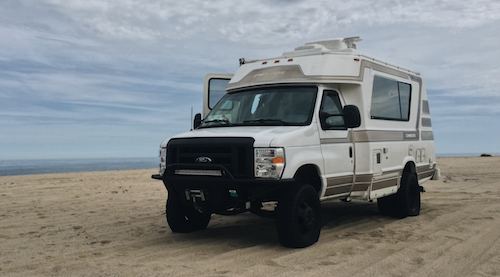
I picked up a 1998 Chinook Concourse this past weekend in preparation for a 6-month long trip with my partner in January. We got this Chinook for a great deal, but she needs A LOT of work which I'm willing (and excited) to do. One of the first issues I'd like to address with the vehicle is that the rear tail lights and marker lights do not turn on. I have been referencing the following viewtopic.php?t=548&hilit=tailight to find the issue, but I believe the previous owner did some electrical work himself so I think I'm going to have trouble following the original thread.
I've attached pictures for your reference, but from what I have learned it seems like the first item to check is the fuse box (image attached). I checked the top left 7.5A fuse and other than the fuse box being held in place by duck tape (which I've removed) the fuse seems fine (I replaced it with a new 7.5A fuse just to be safe).
I then made my way under the rear of the vehicle where the brown connector is located (I believe in this forum you reference this as a "schnozzle"). I learned that this connector is where the wires that power the tail lights and marker lights is located. I'm not certain which colored wire powers the tail lights and the marker lights, but I took a couple of pictures for your reference. When I was moving the wires around, the white wire broke off at the crimp connection while conducting the inspection. This might have been the issue all along or I might have disconnected power to something else entirely. I'm not really sure what to do next.
Should I remove the crimp connection for the white wire all together and just solder everything back with a heat shrink tube cover? Does this white wire even power the tail lights and/or marker lights? Any help would be greatly appreciated.
Tail Lights and Marker Lights Not Working
-
inacioface
- Posts: 50
- Joined: October 3rd, 2022, 6:32 am
- Location: Bethlehem, PA
Tail Lights and Marker Lights Not Working
- Attachments
-
- Disconnected white wire
-
- Brown connector
-
- Fuse box
1998 Chinook Concourse (Rear Entry) | Ford E350 Triton V-10 Chassis
Re: Tail Lights and Marker Lights Not Working
The white wire is ground, so it the connection is good, you should be able to use a volt meter on DC mode, and see no voltage potential, and when you measure the resistance, it should be zero to the chassis. Nothing will work if the ground is not working.
The wire at the brown connector is the right place to trouble shoot. The marker wire does not go from there up, but instead, go all the way to the front on a small wire, thru the fuse box near the left leg of the driver, then came all the way back again before going to the marker lights. Test the connect at the brown connector and confirm that all the wires are working as expected. You should have the marker, left and right turn, and backup working there.
You may find the following thread helpful to you. viewtopic.php?f=9&t=725
The wire at the brown connector is the right place to trouble shoot. The marker wire does not go from there up, but instead, go all the way to the front on a small wire, thru the fuse box near the left leg of the driver, then came all the way back again before going to the marker lights. Test the connect at the brown connector and confirm that all the wires are working as expected. You should have the marker, left and right turn, and backup working there.
You may find the following thread helpful to you. viewtopic.php?f=9&t=725
2000 Concourse dinette, on 1999 6.8L Ford E350 Triton V-10 Chassis
-
inacioface
- Posts: 50
- Joined: October 3rd, 2022, 6:32 am
- Location: Bethlehem, PA
Re: Tail Lights and Marker Lights Not Working
chin_k,
Thank you for the advice. From the link you provided, I found the following wire color legend:
Brown = tail/marker
Yellow = left turn/stop
Green = right turn/stop
White = ground
Prior to breaking the white wire (ground) connection, both turn signals and brake lights work (yellow and green wires). My tail lights and marker lights do not work, which are connected to the brown wire coming from the brown connector. As you indicated, the brown wire looks like it goes back to the front of the vehicle.
I have a volt meter, but I'm not sure how to test for voltage potential or resistance on this wire. For voltage potential, do I disconnect the brown connector and connect one probe to the pin connector and the other probe to ground (i.e. the chassis)? Do I do the same for measuring the resistance?
Thank you for the advice. From the link you provided, I found the following wire color legend:
Brown = tail/marker
Yellow = left turn/stop
Green = right turn/stop
White = ground
Prior to breaking the white wire (ground) connection, both turn signals and brake lights work (yellow and green wires). My tail lights and marker lights do not work, which are connected to the brown wire coming from the brown connector. As you indicated, the brown wire looks like it goes back to the front of the vehicle.
I have a volt meter, but I'm not sure how to test for voltage potential or resistance on this wire. For voltage potential, do I disconnect the brown connector and connect one probe to the pin connector and the other probe to ground (i.e. the chassis)? Do I do the same for measuring the resistance?
1998 Chinook Concourse (Rear Entry) | Ford E350 Triton V-10 Chassis
Re: Tail Lights and Marker Lights Not Working
Just use the voltmeter function for now. Put the black lead on the ground/chassis or grounded line like the white wire, and the red lead on the wire that you knew supposes to be "hot" (have voltage of ~12 volt relative to the ground). If you see that it is 12V, then follow it to the next test point. For the marker light to work, I think you need to turn on the switch over the driver control overhead. I think the switch should be after the Ford connector, so you should be able to get the voltage there. If nothing there, then you may have to test for voltage at the fuse box under the hood then.
The ohmmeter portion of the meter is useful if you do not want to power up the system, but for this troubleshooting, you can just do it with the power on. It should be pretty logical if you view the wire as river, and you just checking at different places along the river bed to see if there is water there. If you see the river is dry, you know there is a beaver dam somewhere up the river.
I do think the first step is to repair the broken white wire. If there is enough slack on the wires, you can just cut the "butt" connector off, and redo the connection. If there is not enough slack, you will need to remove the old connector and preserve as much of the wire as possible so that you can redo the connection without making the wire too short.
The ohmmeter portion of the meter is useful if you do not want to power up the system, but for this troubleshooting, you can just do it with the power on. It should be pretty logical if you view the wire as river, and you just checking at different places along the river bed to see if there is water there. If you see the river is dry, you know there is a beaver dam somewhere up the river.
I do think the first step is to repair the broken white wire. If there is enough slack on the wires, you can just cut the "butt" connector off, and redo the connection. If there is not enough slack, you will need to remove the old connector and preserve as much of the wire as possible so that you can redo the connection without making the wire too short.
2000 Concourse dinette, on 1999 6.8L Ford E350 Triton V-10 Chassis
-
inacioface
- Posts: 50
- Joined: October 3rd, 2022, 6:32 am
- Location: Bethlehem, PA
Re: Tail Lights and Marker Lights Not Working
chin_k,
I reread the Chinook manual and it mentioned that the high beams must be in the "on" position in order for the switch over the driver control to turn on. I tried it with the high beams on and the little red led on the "driver lights" switch illuminated, but the tail lights and the marker lights did not turn on. The brakes and turn signals still work though. As suggested, I will attempt to repair the broken wire tomorrow evening and then use the multimeter to see if water is flowing through the river
I'll let you know what I find.
I reread the Chinook manual and it mentioned that the high beams must be in the "on" position in order for the switch over the driver control to turn on. I tried it with the high beams on and the little red led on the "driver lights" switch illuminated, but the tail lights and the marker lights did not turn on. The brakes and turn signals still work though. As suggested, I will attempt to repair the broken wire tomorrow evening and then use the multimeter to see if water is flowing through the river
I'll let you know what I find.
1998 Chinook Concourse (Rear Entry) | Ford E350 Triton V-10 Chassis
Re: Tail Lights and Marker Lights Not Working
The switch on the driver overhead is for the light right under the front bumper, IIRC. These lights should come on only with the ignition key on the "ON" or "ACC" position, independent of the low beam or parking light or the high beam which is related to the pull-out switch near the steering column. Maybe my rig was wired incorrectly, but mine does not come on when I put the high beam on without the key in the ignition. It will be nice if you can confirm if you have a chance.
The marker lights, however, can be turn on with the driving light without the key.
The marker lights, however, can be turn on with the driving light without the key.
2000 Concourse dinette, on 1999 6.8L Ford E350 Triton V-10 Chassis
-
inacioface
- Posts: 50
- Joined: October 3rd, 2022, 6:32 am
- Location: Bethlehem, PA
Re: Tail Lights and Marker Lights Not Working
I do not have a light under my front bumper... Also, I confirmed that the "driving lights" switch LED only turns on when my high beams are on.
But that's ok, I more concerned about the tail lights and marker lights.
I got under the van last night (while it was raining ) and reconnected the loose white wires. I stripped all three white wires at the crimp and temporarily tied them together with a wire nut (for now). I then followed the dark and light brown wires from the brown connector in the rear of the van to the front of the van, removed the black plastic foot step cover on the drivers side, and to the chinook fuse box. I didn't see any damage or loose wires throughout this path.
I was unable to use the voltmeter at the brown connector to see if I'm getting 12 volts relative to ground; there wasn't any exposed wiring. I did test to see if I was getting 12 volts at the chinook fuse box and noticed that when I placed a lead on the 7.5A fuse and another lead on the chassis, I did not get 12 volts, but when I did this with the other fuses, I did get 12 volts. I'm not sure what this means, but my assumption is that something is wrong.
This morning I did some more investigating. I pulled some of the marker lights from their housings and found some water in the marker housing itself. I pulled some of the bulbs from their connectors and the connections seemed a little corroded and one bulb looked burnt (photo attached).
If one of these bulbs is burnt, would that prevent the rest of the markers (and tail lights from working)? Wouldn't a burnt bulb cut the circuit?
Thanks again for you continued help!
But that's ok, I more concerned about the tail lights and marker lights.
I got under the van last night (while it was raining
) and reconnected the loose white wires. I stripped all three white wires at the crimp and temporarily tied them together with a wire nut (for now). I then followed the dark and light brown wires from the brown connector in the rear of the van to the front of the van, removed the black plastic foot step cover on the drivers side, and to the chinook fuse box. I didn't see any damage or loose wires throughout this path. I was unable to use the voltmeter at the brown connector to see if I'm getting 12 volts relative to ground; there wasn't any exposed wiring. I did test to see if I was getting 12 volts at the chinook fuse box and noticed that when I placed a lead on the 7.5A fuse and another lead on the chassis, I did not get 12 volts, but when I did this with the other fuses, I did get 12 volts. I'm not sure what this means, but my assumption is that something is wrong.
This morning I did some more investigating. I pulled some of the marker lights from their housings and found some water in the marker housing itself. I pulled some of the bulbs from their connectors and the connections seemed a little corroded and one bulb looked burnt (photo attached).
If one of these bulbs is burnt, would that prevent the rest of the markers (and tail lights from working)? Wouldn't a burnt bulb cut the circuit?
Thanks again for you continued help!
- Attachments
-
-
-
1998 Chinook Concourse (Rear Entry) | Ford E350 Triton V-10 Chassis
Re: Tail Lights and Marker Lights Not Working
The burnt bulb meant that the light was working at one point. They are wired to the power in parallel, so one damage/missing bulb does not prevent any other from lighting up. Make sure there is at least one good bulb among the marker lights.
If you don't get 12 volt at the fuse box, you need to go backward. First, now that the white wire is connected, does your left and right turn signals working? Then you need to make sure you know how to turn on the marker light. I think when the beams is on, the marker lights should also come on. Some one else will need to confirm that...
You will need to do the following: 1, figure out the right way to turn on your lights. 2, test for proper ground (negative) from the bulb socket. 3, test for power (positive) from the bulb socket and follow the wire all the way to the battery.
To test for proper ground, you can use the continuity meter (the multimeter typically will beep in this mode) and touch the white wire on the socket with one lead, and chassis ground on the second lead. If it beeps, then that wire is connected to ground.
To test for proper power, you can use the continuity meter and check for connection from bulb to the fusebox, then from fusebox to the Ford connector. This way, you can tell if there is any short without worry about having to turn on the power to the lights.
If you don't get 12 volt at the fuse box, you need to go backward. First, now that the white wire is connected, does your left and right turn signals working? Then you need to make sure you know how to turn on the marker light. I think when the beams is on, the marker lights should also come on. Some one else will need to confirm that...
You will need to do the following: 1, figure out the right way to turn on your lights. 2, test for proper ground (negative) from the bulb socket. 3, test for power (positive) from the bulb socket and follow the wire all the way to the battery.
To test for proper ground, you can use the continuity meter (the multimeter typically will beep in this mode) and touch the white wire on the socket with one lead, and chassis ground on the second lead. If it beeps, then that wire is connected to ground.
To test for proper power, you can use the continuity meter and check for connection from bulb to the fusebox, then from fusebox to the Ford connector. This way, you can tell if there is any short without worry about having to turn on the power to the lights.
2000 Concourse dinette, on 1999 6.8L Ford E350 Triton V-10 Chassis
-
inacioface
- Posts: 50
- Joined: October 3rd, 2022, 6:32 am
- Location: Bethlehem, PA
Re: Tail Lights and Marker Lights Not Working
I used a 12V power supply to test the four rear marker bulbs and all of the work but one. The picture I showed earlier is of the burnt one, but as you mentioned, since it is all wired in parallel, the rest of the marker lights should still work.
Yes, the left and right turn signals work and I'm pretty sure the tail light turn on when I turn the head lights on, but someone will have to confirm this for me as well.
If I understand you correctly, I should use my multimeter to test for proper ground from the bulb socket using the continuity mode on the multimeter. I connect one lead to the ground in the socket (?) and connect the other lead to chassis ground, correct?
How do I check continuity from the bulb socket to the fuse box if my leads aren't long enough? Can I just connect a long wire to the tip of one of the leads to reach the fuse box? Also, isn't there a fuse box under the hood? Should I check that one as well?
Yes, the left and right turn signals work and I'm pretty sure the tail light turn on when I turn the head lights on, but someone will have to confirm this for me as well.
If I understand you correctly, I should use my multimeter to test for proper ground from the bulb socket using the continuity mode on the multimeter. I connect one lead to the ground in the socket (?) and connect the other lead to chassis ground, correct?
How do I check continuity from the bulb socket to the fuse box if my leads aren't long enough? Can I just connect a long wire to the tip of one of the leads to reach the fuse box? Also, isn't there a fuse box under the hood? Should I check that one as well?
1998 Chinook Concourse (Rear Entry) | Ford E350 Triton V-10 Chassis
Re: Tail Lights and Marker Lights Not Working
yes, check the ground wire to make sure the ground wire is working. if your meter does not have enough length for the probes, you can extend it with additional wire. Do not do this with 120V AC, obviously for safety reason, but I think it is fine for 12V DC. Test for voltage to make sure the wire is not energized since it may damage your multimeter. and if you are extra careful, put a 1 A fuse in the middle of the extension wire if you want to be safe. Not fun to touch part of the ground and accidentally burn up a fuse, or worse, a length of wiring on the rig. Alternatively, you can remove the negative terminals from the batteries (both chassis and coach) as well as your solar panel.
I would do it segment-by-segment. Go from socket to the fusebox near the right knee of the driver, to the brown connector, then to the fusebox under the hood, then to the battery terminal. There is a switch somewhere, for my case, it is the driving light knob that needs to be pulled out, but it sounds like you have a different arrangement, which confuses me.
I would do it segment-by-segment. Go from socket to the fusebox near the right knee of the driver, to the brown connector, then to the fusebox under the hood, then to the battery terminal. There is a switch somewhere, for my case, it is the driving light knob that needs to be pulled out, but it sounds like you have a different arrangement, which confuses me.
2000 Concourse dinette, on 1999 6.8L Ford E350 Triton V-10 Chassis